"Everyone else seems to have friends except me."Plus: The Pressure of Becoming Friends with Your College Roommate
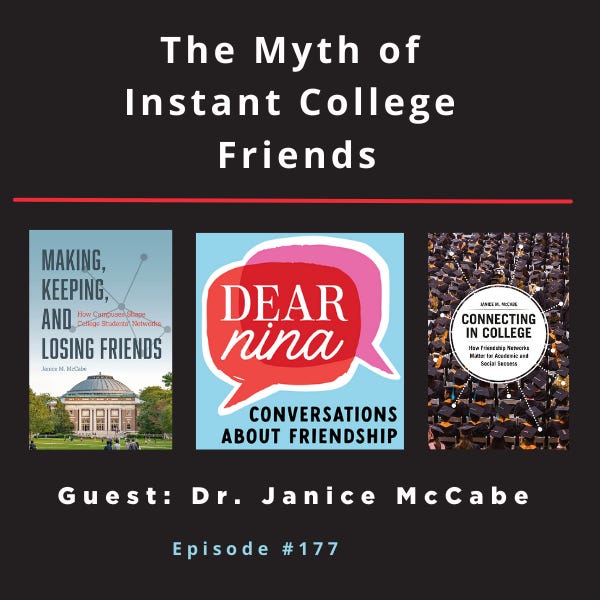
Assuming everyone else has it easierA common sentiment I hear from readers and listeners (whether they’re teens or adults) is some version of this: Everyone else seems to have friends except me. In college, that belief can feel especially brutal starting with choosing “the perfect” roommate, but will get to that in a moment. On a traditional college campus, you’re surrounded by people all the time. You see groups forming quickly. Text threads appear overnight. Groups of floormates walk to every meal together. Everyone seems busy, booked, and socially full right away. And if you’re not immediately part of that, it’s easy to assume you did something wrong, or that you missed your chance, or that you’re the only one you didn’t make “instant friends.” The Myth of Instant College FriendsIn episode 177 of Dear Nina, I spoke with Dartmouth College sociologist, Dr. Janice McCabe, author of two books: Making, Keeping, and Losing Friends: How Campuses Shape College Students Networks and Connecting in College: How Friendship Networks Matter for Academic and Social Success about why the assumption that everyone else has it easier is both powerful and misleading. One of the most grounding ideas we discussed is that friendship is not just about personality, confidence, or effort. It’s also about the structure some college campuses make more approachable than others and taking advantage of those opportunities. We spoke about the research Dr. McCabe has done on friendship markets and how to figure out, as a college student, which markets are “open” and which are “closed.” This is also excellent advice for any stage of life such as moving to a new city or entering a new stage of life, or even when you feel your social life isn’t as strong as you’d like. Here’s the truth about those early college groups you might see forming seemingly overnight: Many of those initial groups are temporary. They shift. They shrink. Some fade entirely by second semester. ALSO: The roommate pressure is out of control these daysNowhere is this “instant friendship” pressure more obvious than with the roommate search that begins senior year of high school. Dr. McCabe and I spoke about the way Dartmouth College still requires random roommate matches with the use of a questionnaire to assess living styles more than anything else. (How late you like the light on, how warm or chilly you like the room, how messy or neat you are.) For most schools nowadays, before college even starts, there’s a scramble to find a roommate via social media or through mutual friends. Students match based on shared “online aesthetics” and the assurance of a similar background. Parents watch this process unfold with a mix of fascination and anxiety. No one wants their kid to be the one who wasn’t chosen. No student wants to feel not chosen. But as Dr. McCabe explains, similarity doesn’t equal compatibility. Liking the same clothes or brand of iced coffee doesn’t tell you whether someone keeps the lights on until 3 a.m., needs quiet to study, or cleans the room once a semester. Yet many students arrive on campus believing their roommate is supposed to become their built-in best friend. That expectation alone can create daily stress. When it works out with your pre-chosen roommate, fantastic. When it doesn’t, students can feel like they failed at friendship before the first weeks have passed. In reality, roommates don’t need to be close friends to be a good match for living together. The ideal is simply a respectful, neutral relationship. That would be an enormous success! No matter your age/stage . . .Friendship is a process. It takes repetition. It takes proximity. It takes trying, recalibrating, and moving on from situations that aren’t working. And yes, it takes longer for some people than others. And it takes longer for almost everyone than enough people are willing to admit. I wish people spoke about this more during college tours! If this feels close to homeIf you’re a parent reading this and you’re worried about a student who seems unhappy after first semester or socially disconnected, I hope this episode offers a little relief. If you’re a student reading this: you didn’t miss your chance. You’re not doing college wrong. And the story you’re telling yourself about how great “everyone else” is doing socially is almost certainly untrue. Listen to episode #177 on Apple, Spotify, YouTube, and anywhere you listen to podcasts! Books, Shows, & Recipes I’m Into These Days
My Friends/Family Convinced Me to Try This
Two Anonymous Letters You Might Have Missed
Let’s connect outside of this newsletter: You can find me most often in the Facebook group, Dear Nina: The Group. All the social media links are below. I know I need to get rid of some them! Instagram | TikTok | YouTube | LinkedIn | My Website You’re a free subscriber to Dear Nina: Conversations About Friendship. What do you get if you’re a paying subscriber!** Frustrated with some of your friends? You’re not alone! The anonymous letters are a perk for paying subscribers. You probably have a similar question. Upgrade any time. **Yearly subscribers can email me one detailed friendship issue at ninabadzin@gmail.com and I will email you back personally.
|
Friday, 26 December 2025
"Everyone else seems to have friends except me."







Subscribe to:
Post Comments (Atom)
When in Doubt, Make Salsa 🍅
Winter escape 🌴 planning, a Rome hack and easy fall recipes ͏ ͏ ͏ ͏ ͏ ͏ ͏ ͏ ͏ ͏ ͏ ͏ ͏ ͏ ͏ ͏ ͏ ͏ ͏ ͏ ͏ ͏ ͏ ͏ ͏ ͏ ͏ ͏ ͏ ͏ ͏ ͏ ͏ ͏ ͏ ͏ ͏ ͏...
-
Lit Hub Excerpts posted: " I went to work and a guy I wait on said he was leaving. He said everyone he knew was pu...
-
Sheri K posted: " #*insert person/company name*isoverparty or #*insert person/company name*iscancelled How often do you ...


No comments:
Post a Comment