There have been plenty of moments when I've looked around at the world I came of age in and wondered, "What are we supposed to do with this?" I go about my life in a constant state of waiting for the next crisis to break. It feels like History with a capital H is accelerating.
On my third day of high school, about five blocks away from the World Trade Center, I looked out the classroom window and saw a commercial plane descending toward us out of the sky. Evacuation was not orderly. A gym teacher told us to "walk north," and so we walked, dust clouds still settling, in scattered, scared groups without adults, stopping to glean the news from car radios.
Since then, it's been blackouts and super storms, recessions and pandemics. I catch myself feeling angry with previous generations, who were either oblivious or who knew better and delivered us this Earth anyway.
In 2012 after Sandy, as we waited for the National Guard to roll into a powerless Lower Manhattan to distribute water and meals to residents, I remember feeling wonder at how quickly the world had turned strange, like we had unknowingly stumbled to the precipice of great change—and not the good kind.
I've been thinking about how the current context has shaped my generation's readers and writers, specifically in the area of science fiction. I think dystopia is attractive because even as it presents a fundamentally broken situation, it usually offers the possibility of repair: think Hunger Games, Divergent, and Maze Runner, all popular books when I was a young adult. And all of them are about burning down the current system in search of something better. They also implicitly question whether older generations really did right by the next—even as they insist, often wrongly, Well, This is How Things Just Are.
I wrote my debut novel, The Deep Sky, during the most intense parts of the pandemic, and I found a lot of my own big, intense feelings boiling up to the surface as I wrote. It's set in the near future, when all the bad things now have gotten worse. Climate change, for example, has not been dealt with, and domestic and global conflict has only gotten worse because of it.
The main character, Asuka, fights with her mother about what her future should be. Against her mother's wishes, she joins part of a crew of people in their twenties naively determined to go off and make a fresh start for humanity even as the world behind them descends into chaos. Part of her decision to join the mission stems from a desire to prove her mother wrong (only to realize maybe she was right). At the same time, her mother is making a well-intentioned if misguided attempt to repair the mistakes of her own generation.
That's the other thing about science fiction: there's always the possibility of hope when you're looking forward.
A lot of this year's science fiction seems to tap similar feelings—anger about societal systems and oppression, and that moment when you learn that the older figures you trusted to help you, are not in fact going to: they can't or they won't.
In Some Desperate Glory by Emily Tesh, a young, brainwashed woman raised in an extremist state, goes on a rogue mission to save her brother and achieve glory for herself. As the novel unfolds, she realizes how dirty the older generations did her, and tries in several different ways to fix the world. Each time, she collides against the seeming futility of it but continues to persevere.
Jack Albright in Scourge Between Stars by Ness Brown is the First Mate of a deteriorating generation ship making its way home after a failed mission. Her father, the Captain, has retreated to his room and won't open the door as monstrous things stalk the crew, no matter how she bangs on his door and begs him to help.
When I raised the idea of generational rage to fellow debut science fiction authors, it seemed to resonate with a lot of them. You see the themes in their books, the premise that the future isn't some shiny thing, but a world (sometimes literally) on fire.
In Mia V. Moss's debut novella, Mai Tais for the Lost, humanity has retreated underwater rather than the sky; the world above surface is still on fire. In J. Dianne Dotson's (trad) debut, The Inn at the Amethyst Lantern, the sun is so hot, humanity has had to resort to "Night Living." Kristy Gardner's Earth in The Stars in Their Eyes is not only dying but decimated by aliens. And in World Running Down by Al Hess, those with means have run off for a new world, and the ones left behind are forced to scavenge in hot desert unless they're lucky enough to gain citizenship in a city-state with universal free healthcare.
But what I notice across these books is not just that the future worlds have become near-uninhabitable, it's that even when there are villains, the biggest problem is generally society itself.
Kritika Rao's trilogy is literally called "The Rages Trilogy." Her debut book, The Surviving Sky, is set in a world with devouring storms and a human race that has retreated to the sky. Society is wholly dependent on the supremacy of an elite few and most are afraid to question it. When talking to Kritika, she noted, "a lot of the anger and helplessness Ahilya [her main character] feels came from my own anger and helplessness when it comes to big societal problems."
Like Kritika, I grew up believing the future would be—should be—better than the past. And then you have headlines pop up on your phone, sometimes several times a week, informing you that your rights are being whittled away, ecosystems are likely to collapse sooner than expected, and there was another mass shooting somewhere, and you understand that progress is not guaranteed. There was a Gallup poll in 2022 that reported less than half of U.S. adults think kids today will have a better life than they have.
Rebecca Fraimow embraces this generational rage in The Iron Children, where characters struggle for literal survival in a military-dominated society. Rebecca explained to me, "I really wanted to write something in which the problems are societal/institutional, created by decisions made by previous generations, and not solvable by any simple gordian knot methods that our protagonists could achieve like Winning This One Battle or Killing That One Guy."
Like Rebecca, as a reader and a writer, I find I'm increasingly interested in how to actually change things—like when you find yourself in an argument about whose fault something was for a good half hour before someone finally interjects, "okay, but how are we going to solve this?" I'm thirty-five; I'm cognizant that even now my own generation is becoming the perpetrator of the problems.
And that's the other thing about science fiction: there's always the possibility of hope when you're looking forward. The stories are about finding the means to change things. You can be angry, but you can also escape the fascist state you were born into and dig out oppression by the roots; you don't need your dad to hunt the thing that's killing your crew; you can say no to the job that is fundamentally wrong; you can fight to keep your city from crashing into storms; and you can board a ship to start over on a new world all your own.
__________________________________
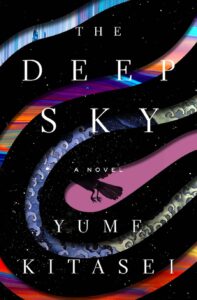
The Deep Sky by Yume Kitasei is available from Flatiron Books, an imprint of Macmillan, Inc.




No comments:
Post a Comment