There's a story Gramps likes to tell about one of my early visits to his farm. I must have been two or three. Toddling. We are walking toward the barn, and I am running ahead in grass already mowed to fuzz by the herd, probably chasing butterflies, those ones that appeared each spring to surf the breeze like shreds of torn lavender tissue paper. I turn a corner, round a hill, and stop. I've seen something. Made eye contact with it.
"Gramps!" I say, breathless, running back to his ambling frame, his boots nearly my height. "A wolf!"
There's an animal ahead, eyes glassy but alert, neck hooked in a metal snare trap. As an environmentalist Gramps believed in the conservation of wild spaces and their inhabitants, but here on the farm he was a tender, and he reckoned those two aims with little angst. His responsibility for the sheep was love but also business. His job was to keep the flock alive.
On the ground, from a distance, the animal is my size. For a second we watch each other. Her breath surely labored. Did she know she would die? Did I? Gramps will shoot her, or he will call ODFW, or she will die on her own, the blood at her neck already thickening in the fur where she has tried to tug away.
Maybe I saw panic in the animal's eyes and mistook it for my own.
It's not a wolf, Gramps knows that immediately. There are no known wolves in Oregon at this point in the early 1990s. My wolf is just a coyote. But I am a child and I know only stories, and the wolf in my stories looms big. The wolf is the beast that gets the sheep, and I love the lambs, I lean over the rose-colored bathtub and help bottle-feed the ones whose mothers have, for whatever reason, turned away. What did I feel watching the predator? I would like to think I cried on instinct, aware I was witnessing a brink of death, but I'm not sure.
There is a chance I may have felt like we had won. Like this was the last threat; like we had saved the lambs. Or maybe—and this is worse to consider—I saw the animal I thought was a wolf and I did not realize that we had won. Maybe I thought the animal was still a threat, so I ran to grab my grandfather's hand. Maybe I saw panic in the animal's eyes and mistook it for my own.
Gramps does not have answers to tell me about what happened after I got him. When I asked, recently, he waved it off, eyes floating elsewhere. He began to tell another story. So many of his stories are tall. Stretched, sculpted. Does it go without saying I have no memory of the encounter with the trap? No memory of the creature I thought was wolf. No memory of what twitched inside me when—if—I rounded the corner, alone, and looked her in the eye.
In French, the word loup means wolf, but in other contexts, it can also mean other things. An error in calculation, for example. Pluralized, it's the black velvet mask worn at a costume ball. Both definitions suggest one's first impression of a wolf is wrong, or rather, imperfect. The truth is not always what it seems.
When I began researching wolves, I believed my first wolf sighting was in the Lamar Valley. Snaked by the Lamar River and rutted by creeks, this Edenic prairie is sometimes referred to as America's Serengeti. It's the part of Yellowstone National Park you don't go to if you are playing geothermic bingo, where it's harder to find a lodge to sell you hot chocolate than it is to see a herd of pronghorn. I now know it as the part of the park where wolves were flown in from Canada in the 1990s.
The sighting was on my first trip to Yellowstone. I was eleven, waiting for middle school with the resignation of a sailor facing hurricane season. Self-consciousness radiated from my fuzzy legs, the choker necklace I had clipped together with bead-strung safety pins my only talisman. That week my parents had left my sister and me with my maternal grandparents in Montana, so my then-fifty-something grandmother, Sally, loaded us into a car with her own mother, then drove us to the park. For a day or two, she rustled us from dark motels in pastel hours, telling us if we wanted to see animals, we had to get on their schedule. I was skeptical. Witnessing an animal had rarely left an imprint on my own life.
The last morning started before sunrise. We hadn't been driving long when Sally pulled to an overlook above a cliff and shook our ankles. Enough dozing. Out. In the brown grass below, a herd of bison inched toward the growing orb of sun across the valley. Through the aura of dust that followed their path, it became clear that two animals were staying behind. The smaller one lay like a boulder in the grass. I don't remember if she faltered and failed to get up, but something radiated life. A larger bison stood above her, craggy as a statue. Every few seconds she would pivot between the body and the departure of her herd. It wasn't until she, too, started to follow the crowd that I understood what was going on.
How could I forget that mother bison's dance? Grief swung a pendulum between what must have been her sick calf and her herd. She turned multiple times toward each, swinging the tank of her body a few steps in one direction before her hoofs would kick back, clumsily, to correct herself. Attributing human emotion to another animal has traditionally been a scientific minefield, a stance ecologists like Carl Safina now resolutely challenge.
"When someone says you can't attribute human sensations to animals, they forget that human sensations are animal sensations," he writes in Beyond Words: What Animals Think and Feel, noting that if we can detect hunger or exhaustion in an animal, surely we can detect joy when they are playing with their children too. And what is the inverse of joy but grief? The opposite of playing with a child is surely abandoning it. I was no scientist, but I was a daughter. I had little doubt what was going on in the mother bison's mind.
As the sun eased over the mountains, a saccharine, yolky glow leached across the grassland, illuminating the ever-widening expanse between mother and child. Beneath the self-pitying glaze of my preteen self, I felt a surge of sadness so great I thought I would shatter. If the mother's pain was one reality of what it meant to occupy a body on this earth, the dumb distance of our gaze was another. We could play no role but witness. Perhaps because it was all we could do, we could not look away: my great-grandmother in her plastic visor, Grandma Sally in her Tevas, my sister and me in our jean shorts, mouths ajar with city-girl sadness. It was the day I realized watching non-human animals could make you feel things that weren't about being human at all.
Even as the space between bison stretched into what must have been a football field, the mother continued to pause, turning back and forth. I don't remember the questions Annika and I surely asked—Why do you think the herd had to leave now? Do you think the baby was just born sick? Could the mother survive on her own without the herd if she stayed?—or maybe I just don't remember Sally's answers.
The memory has taken on the silent Technicolor of a Disney movie, the ones I grew up hating because the mother always died. It felt as if I still owed the calf my gaze, or owed it to the mother. As if we had promised that though she had had to turn her back, we would not turn ours. In truth, of course, there was no etiquette. We were just animals who had stumbled into another animal scene.
If the memory were a movie, the violin would suddenly quicken. The camera would pan. As the mother shrank into the horizon, the wolves appeared on a nearby hill. They were beady, sunlit, and impossibly fast, like shadows of death itself. At that time, the Lamar Pack would have been in the valley less than ten years. As Nate Blakeslee later wrote in American Wolf, his nonfiction epic dramatizing the life of this very pack, food could be hard to come by. It was common for wolves to follow a herd for days, waiting for someone to get left behind.
It was the day I realized watching non-human animals could make you feel things that weren't about being human at all.
When I told people I was writing about wolves, they often asked if I had seen them in the wild. Oh, I used to say, did I ever. And I recounted this day. My punch line was unsatisfying, though, because I had no memory of the wolves reaching the young buffalo, only the fact that at some point, like the mother, we had turned away. Clicked ourselves into seat belts and driven home.
It is one thing to reference the memory, but in pressing it to the page, my image of tiny running wolves has begun to fray. To stumble out of a car into a big-game feeding is a bit like opening the door to a meteor shower. It is the pulse of nature documentaries, not everyday witness. If we were watching the wolves run toward the calf, I do not think Sally would have let us walk away before we saw what happened. And if we had seen them feed, I am sure I would not have forgotten.
Years later, when I asked if she remembered wolves that day, Sally laughed, shaking a head still naturally sandy blond in her early seventies. She's sensible, her matter-of-fact rationality often throwing the spiraling inquiries of my sister and me into relief.
"I guess they could have come," she said. "I've seen them there before."
"But you don't remember seeing them eat, right?" I felt a creeping dizziness as she shook her head. "I wonder if you just mentioned they could come and my brain filled in the rest—" She raised her eyebrows at me, then, slowly, her head bobbed.
"Yeah," she said, laughing as realization bloomed on my face. "Sorry!"
Whether on Gramps's farm or in Yellowstone Park, my first wolf sightings were only in my mind. I never meant to lie. How had it happened? Even as I understood wolves were not "bad," I had, in fixating on their prey, conflated them with everything that was, anticipating their arrival with the dread-soaked familiarity of all possible endings: illness, heart attacks, house fires. It had been easy to identify with the helplessness of both mother and child, and to want to protect them at all cost.
Still, as Yellowstone Wolf Project coordinator Doug Smith told Safina: "There is no peace for prey in a land without predators. There are only alternate sufferings." In this light, death by wolf can be a form of mercy.
Though I never meant to "cry wolf," I had absorbed a certain type of Big Bad Wolf story so many times it became reflex. The day I realized I invented the Yellowstone sighting was the day I knew to doubt the stories I had been told about fear. Stories about real wolves, but other ones too. Those fictions that rippled through my body as fact, even as I tried to guard against them. I began to mistrust my instincts around the truth.
__________________________________
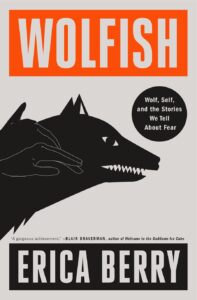
Excerpted from Wolfish: Wolf, Self, and the Stories We Tell about Fear by Erica Berry. Copyright © 2023. Available from Flatiron Books, a division of Macmillan, Inc.


No comments:
Post a Comment