On May 20, 1974, soon after the initial publication of Zen and the Art of Motorcycle Maintenance, Robert M. Pirsig addressed students at the Minneapolis College of Art and Design. The following transcription of those remarks—published for the first time—has been lightly edited for clarity.
*
I want to talk about the creative process. My medium is books or, to put it precisely, a book. Other people work in different media. But I think my creative process is not so different from the one you may go through. And if so, then perhaps some things I say may have value to you. A lot won't. No two people are in the same situation or have the same problems. But in another sense—and this is a contradiction everybody's in the same situation and has identical problems.
Regarding the creative process, I want to talk about two books. The first is the book I never wrote, and the second is the book I wrote. I'd like to contrast how both of those, the book and the non-book, were arrived at and, by comparing the two, try to get an idea of what was going on. And draw some morals and maybe find something useful in that process.
I spent maybe an hour or two hours, and really was beginning to get sort of frustrated, and not willing to admit that maybe what I had come all the way down here for wasn't going to happen.
The first book never did get a title, and, of course, it never got written. But it was going to be a great book. My wife and I were just married. We lived in Reno, Nevada; we were dealers in a gambling casino at that time. I dealt the keno—this was at the Nevada Club—and she dealt the roulette, and we were going to save money. We lived in a cheap trailer and we saved all the cash we could. We figured the only way to beat these casinos is to work for them and take as much out of it as you can, and get out of there, and never spend a cent if you can possibly avoid it. And then go someplace where costs were very cheap, in this case Mexico, and then sit down there and write the perfect book.
So we worked for eight months. This was in 1953 or '54, and at the end we had $3,400 saved, which in the fifties was a huge sum of money, and we hitchhiked, "Bobby McGee" fashion, all the way through Nevada and into Southern California, across Arizona and down into Mexico, and then at the Mexican border got a third-class bus and went down through Mexico City, through Veracruz, way down into the jungles of Mexico and into a tiny little village town called Acayucan.
In Acayucan we got paper, and I bought a Parker 51 pen, and I prepared to write the great book. At first I found a good room, with proper temperature and proper exposure. It was nice temperatures down there, as it was fall getting into winter. Got a comfortable chair and sat down. After about fifteen minutes, after all this preparation, I said, "Well, maybe I should walk a little." I walked a little around town and met various people and talked for a while, and said, "That's very interesting, and now I'll go back and write." And I went back, and I spent maybe an hour or two hours, and really was beginning to get sort of frustrated, and not willing to admit that maybe what I had come all the way down here for wasn't going to happen.
These options for Quality that we feel sometimes are exclusive to the arts, I feel also exist in technology.
So I procrastinated on this and other things for about a week. And at the end of a week I still hadn't written anything. I began to become gradually aware that something was very deeply wrong, that everything I'd set up, everything I'd done to come down here, wasn't right, it was a wrong situation. I was doing it badly. And then at that time an idea came along: "Well, I'll build a boat." And this struck me as one of the most brilliant ideas I'd ever had, of course, about that time, because that got me out of writing.
I tore into this boat with great tenacity. I found that you could get a trained carpenter for twelve dollars a week and you could get pure mahogany at twelve cents a board foot. We were very close to a river town, and I spent the next six months working on a boat. That never got built either, although I still have some of the lumber in my garage, and someday, maybe, I'll get back to it.
So that was the first book. It is a kind of process which I think is important to go through at one time or another. The great effort which produces nothing. The great stymie.
And now, in contrast, I'd like to talk about the second book, called Zen and the Art of Motorcycle Maintenance, which arrived in entirely different circumstances.
At one time I'd sort of been fighting this and now I was trying to enter it as hard as I could, to be a useful person.
I had been a teacher of writing, although I'd never written anything, and had gotten involved with some very difficult and complex ideas about Quality, and as a result wound up in a mental hospital. After I'd come out of the mental hospital, I was ineligible for teaching work—in fact ineligible for any kind of work. I hit the streets down here in Minneapolis and started to apply for jobs one after another. The people you talk to in those circumstances are very friendly, they're very encouraging, but they know they can't do much for you, because in business they try to hire the very best people they can. Once you've got a record of mental illness on you, you're not the best person they can [hire]. They can get scared of people with that kind of background. So I was going through periods of great depression. Finally one firm by accident forgot to ask me about my medical record, and I got a job there.
That firm was Northern Pump, which became Northern Ordinance. A lot of stuff in Zen and the Art of Motorcycle Maintenance was learned out at Northern Pump. It's a great old firm. The tool and die makers out there, the machinists, are real artists, and if you don't know it, just get a job sometime and watch them. They're very limited in their parameters. They don't get much choice. They have to follow blueprints, but they can sure follow them well—or they can follow them poorly. They can do a piece of machinery which is very close, and they can do a piece of machinery which is right on. These options for Quality that we feel sometimes are exclusive to the arts, I feel also exist in technology. And that lesson was learned out there in Northern Pump. It's sometimes called the world's greatest machine shop, and it really is. Entire launching systems are made by hand out there, by people in the end taking a piece of cloth with a piece of pumice on it, taking down the last millionth of an inch, very carefully.
Well, I got a job and got into that work and became a technical writer and worked very hard at this and tried to employ some of the ideas I'd had before the breakdown into the work I'd been doing. It was kind of an absorption into middle-class American life. At one time I'd sort of been fighting this and now I was trying to enter it as hard as I could, to be a useful person. I think that's important.
I wasn't being separate from what I was doing; [the idea] was arising out of what I was doing.
And I felt I did pretty well. I worked for Fabri-Tek for a while and then went to work for a firm called Century Publications, where I became a contract technical writer. This is a person who fills in when there are overloads. They used to call us the "rent-a-bodies" sometimes, or the "Kelly boys." We were the people who, when a firm had a sudden contract and not enough technical writers to fill it, would move in, get a job done very quickly, and then move out again. We got better pay and we were very free, and it was kind of a nice life, a journeyman tech writer life. This I was doing at about '66, '67, '68.
And then in the spring of '68, sitting at an office over in Control Data, writing about the Poseidon missile computers, busy, overloaded, but kind of happy about a motorcycle I had that I'd just fixed, I started to daydream in the office. "Gee, I wish I could do a little essay on how I fixed the motorcycle and how that's not so very different from the abstract ideas of art or the religious ideas of Zen." A friend of mine, John Sutherland, owned a motorcycle and we used to go riding around in the country from time to time, and he had been talking about a book called Zen in the Art of Archery. And I noticed that his Harley was really firing improperly, and I thought at the time that what he really needs is not a book on Zen and the art of archery. He really needs a book on Zen and the art of motorcycle maintenance. And that was where it all started.
I want to emphasize that when that idea came, there was no preparation for it. It arrived out of my own circumstances, rather than out of a deliberate desire on my part to sit down and write. I wasn't being separate from what I was doing; this was arising out of what I was doing.
I'm sure that in any creative project you really can't perceive what the end is going to be, unless it is a very small thing you're doing.
At the University of Minnesota I had a teacher named Allen Tate. He taught poetry there and was quite a famous figure. I had been in India, and I brought in a very beautiful—I thought—essay on an Indian man who used to talk to the crows while he worked. I knew enough Hindustani so I could pick up his voice and get down some of what he was saying. I thought I would write a nice story about that. When I was done, there were almost tears in my eyes, I thought it was so beautiful. So I turned it in to Allen Tate and expected great smiles of appreciation. But his answer was, "What do you want to write about all this exotic stuff for?" He said, "Write about what you know. If you write about what you know, and know personally, and know deeply, and know better than anyone else, that's going to be plenty exotic to everybody else." Anyone who has read Zen and the Art of Motorcycle Maintenance knows how completely that fulfills that definition. It is about what I know, but it certainly is plenty exotic to everybody else.
Now, to get back to the thread, once I'd had the original idea, I started to do this essay, which was just going to be a simple, little kind of clever tongue-in-cheek thing on Zen and the art of motorcycle maintenance. I expected it to take about two or three weeks at first. As I got into it, it became apparent to me that there are some very deep problems here. First, you can't really get from Zen to motorcycle maintenance very fast. Before you get there, you find there are underlying problems that are very deep and seem to get deeper and deeper. And so gradually, I began to discover that I was on to more than I had thought, and that this essay was turning into something quite a bit bigger.
I sat down and had to devise a way of keeping track of what were now very rapidly proliferating thoughts. Normally for a small article or a small essay, you'd use an outline, but you find that when you start getting into something big, the outline gets crossed out so fast that it becomes unusable. What I did for this particular outline was something I'd learned to do in technical writing, and that was to put down each idea on individual slips of paper and then compare them and see which went first. So my outline was always in a series of slips that went on, one after another. This is just a technique, a gimmick you might say, but it turned out, I think, to be a technique that gives Zen and the Art of Motorcycle Maintenance a great deal of its complexity, its fundamental sweep and wholeness, and its unification.
The reviews I've read all seem to regard this as some great act of creativity. It was a very systematic, deliberate act. I was about as creative as an accountant at this point. I was just putting down these slips and comparing them. But this particular form gave me the advantage of being able to expand in the middle, of being able to reorganize at any time, so I had a flexible outline that could grow as my understanding of the story grew. I was never limited. I was free to throw away where I had been and restart again, over and over again, with what was coming in new. And I'm sure that in any creative project you really can't perceive what the end is going to be, unless it is a very small thing you're doing. I think the advantage of this particular device was that it always kept me open, it always kept me flexible, it always gave me a kind of a hollowness, so that I could constantly be refilled with new things that were coming in. The result of this was a book of many levels and of much complexity, but whose levels and whose complexity somehow always seem at the last minute to hang together.
___________________________________
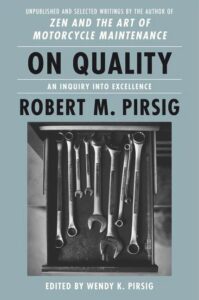
Excerpted from On Quality: An Inquiry into Excellence: Unpublished and Selected Writings by Robert M. Pirsig and Wendy K. Pirsig. Copyright © 2022. Available from Mariner Books, an imprint of HarperCollins Publishers.


No comments:
Post a Comment