This month’s anonymous letter comes from someone who’s wondering if her 25-year friendship can survive a lack of emotional reciprocity (commiseration)— and whether her own envy is part of the story. Have a friendship dilemma? You can tell me about it, anonymously.See more anonymous letters here.Catch up on the podcast here.Dear Nina,I have a friend who never commiserates, and I don’t know if that’s a reason to move away from a friendship, or this is more of an envy problem on my part. Here’s the story: I have had a 25-year friendship with “Kim” and we’ve each raised two daughters, who are now in their late 20s. While raising our children, I would express my struggles with parenting every now and then, but she’d never commiserate. What I mean is, she never expressed that she had anything but an easy times with her girls. Our daughters took the same tracks in life at first. They all went to college, and they all are wonderful human beings. But her daughters took the more traditional (the more secure) route of the 9-to-5 job, whereas my daughters are freelancers and entrepreneurs. Her daughters are great savers and have both purchased homes. My daughters are not savers and rent. Kim and I now live far away from each other since we retired so we only speak on the phone instead of seeing each other face-to-face, but once again there is no commiseration. Kim’s girls, according to her, are picture perfect and everything is going great, whereas my girls, as wonderful as they are, find themselves struggling because they’ve chosen different paths in life. As I’m writing this I think part of the problem is in my own acceptance that my children have taken less traditional paths. I also recognize that Kim’s girls take her advice and her husband’s advice very seriously so they’ve done things like ask for help on how to be financially secure and they’ve listened and followed through with that. My husband and I have given the same guidance, but our girls are more headstrong/independent and choose to not heed. I’d love some feedback on how to handle a friendship in which one person can’t at least commiserate on some level so that you know you’re not standing alone with these things in your life. Also, how do I tame the envy I feel that her daughters are thriving and mine are struggling. And finally, I wonder if what she has been doing throughout our long friendship is using toxic positivity? Thanks, Just Want Someone to Commiserate Dear Just Want Someone to Commiserate,...Continue reading this post for free in the Substack app
|
Wednesday, 15 October 2025
The Friend Who Never Commiserates






Wednesday, 8 October 2025
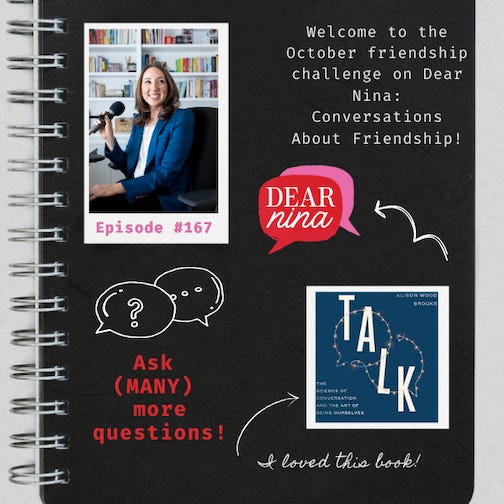
Ask (MANY) More Questions: October Friendship Challenge
Every month on Dear Nina (the podcast) I offer a small challenge to deepen/revive the friendships already in our lives OR to make new friends. I say “our” because I do the challenges too. You can see the 2025 challenges here. For October: Ask your friends (A LOT) more questions!This month’s challenge is simple but powerful: ask your friends more questions. Ask way more than you think you should. Trust me, people notice when you’re not showing interest in their lives and follow-up questions are the key to demonstrating interest. One of my most viral TikToks from last fall was when I talked about “the friend who never asks about you.” It has over 90K views and over 400 comments. People had intense and NEGATIVE feelings on this topic and LOTS to say about friends who don’t ask questions. About three months after I made that video, I read Talk: The Science of Conversation and the Art of Being Ourselves by Harvard Business School professor Alison Wood Brooks. The letters of “TALK” stand for: Topics, Asking, Levity, and Kindness. I recommend the entire book to understand the art of connecting with your conversation partner, but this month’s Dear Nina Friendship Challenge focuses on the “A” in “TALK,” asking questions. The most impactful study Professor Brooks shares in that chapter is that most of us assume we ask plenty of questions, but research shows we’re asking far fewer than we think. This is why some of us leave a conversation feeling deflated or less motivated to get together with that friend again. Here is the October assignment (or do it any month you’re reading this).
When you’re interested, you become interesting!Listen to episode #167 on Apple, Spotify, YouTube, and anywhere you listen to podcasts! Let me know how it goes!REMINDER: You can start the 2025 challenge any time. Each month is meant to stand alone and you don’t need an entire month to accomplish any of them. Come back and let me know how it went no matter when you try that month’s “assignment.”
Two anonymous questions you might have missed
Let’s connect outside of this newsletter: You can find me most often in the Facebook group, Dear Nina: The Group. All the social media links are below. I know I need to get rid of some them! Instagram | TikTok | YouTube | LinkedIn | My Website You’re a free subscriber to Dear Nina: Conversations About Friendship. Frustrated with some of your friends? You’re not alone! The anonymous letters are a perk for paying subscribers. You probably have a similar question. Upgrade any time for the full archive.
|



-
Sheri K posted: " #*insert person/company name*isoverparty or #*insert person/company name*iscancelled How often do you ...
-
Lit Hub Excerpts posted: " I went to work and a guy I wait on said he was leaving. He said everyone he knew was pu...


