
The Reassurance Trap in FriendshipThe hidden cost of needing constant proof that everything is okay
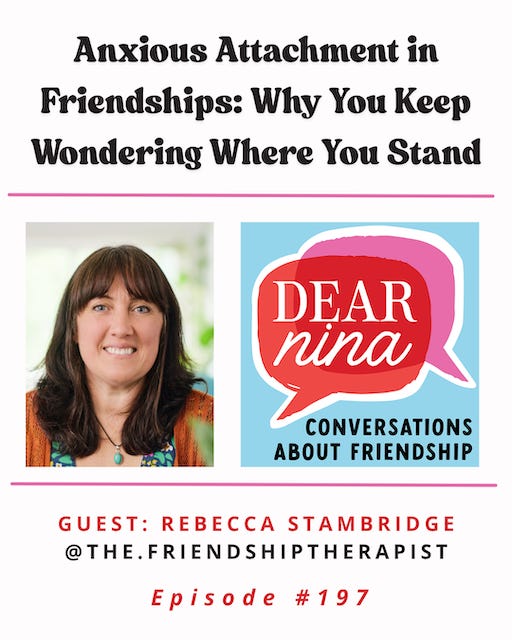
When the need to feel secure in a friendship starts creating distance . . .Most of us rely on some level of unspoken (or spoken!) reassurance from friends at different points in the friendship. Perhaps at first we want to know they’re interested in being friends, then later that the friendship matters to them. We want to know they’re not terribly upset with us if we made a mistake, or that the friendship is still “okay” if there was a disagreement. All of this is normal—to a degree. To what degree? There’s no rule. But a constant need for reassurance is not healthy for you. And it’s exhausting for your friend. The problem begins when reassurance becomes something we need repeatedly, urgently, or in a very specific form in order to feel “safe” in the friendship. At that point, as this week’s guest, Rebecca Stambridge, MBACP —known as The Friendship Therapist , explains, we may be asking a friend to regulate our anxiety rather than learning to regulate it ourselves. An example: A friend cancels plans and doesn’t text back for two days. Perhaps this is unusual behavior for her, but rather than thinking, I’m worried something is going on with my friend, you end up thinking, Did I do something wrong!? When she does text you two days later, she apologizes profusely and explains what kept her from getting in touch earlier. You’re extremely relieved with this signal that everything is fine with the two of you. The relief doesn’t last though. You read into all of her texts, always looking for clues that she doesn’t want to reschedule. This is the trap of constantly needing reassurance from a friend. And according to Rebecca, it’s a common pattern she sees in her work with people who struggle with anxious attachment in their platonic relationships. “Vulnerable Self-centeredness”Rebecca introduced me to a phrase I haven’t been able to stop thinking about: vulnerable self-centeredness. Not self-centered in the way we usually mean it, but self-centered in the sense that when something seems off in a friendship, we instinctively make it about us. A friend isn’t liking your Instagram posts? She thinks I’m annoying or she doesn’t support me. She’s taking longer than usual to respond? I must have upset her. Rebecca said, “Our mind does not know the difference between a thought and reality. If your mind has created a thought that a friend doesn’t care about me, it will feel real. You’ll feel rejected. You’ll feel physical pain.” And I’d like to add that your mind will keep looking for evidence. Sometimes the fear of losing a friend is what strains the friendship.The very behavior that anxiety drives us toward—such as forcing a friend to once again reassure us things are fine—can create the distance we’ve been worried about all along. The friend can become exhausted with this pressure and that’s when a friend might ask for space, or not ask but simply create it. A healthy friendship can provide support, but a friend can’t be responsible for regulating all of our fears about the friendship itself. How do you know when you’re expecting your friend to manage your friendship anxiety versus merely expecting a friend to show up for you as any friend should?Rebecca said, “Anything where you are trying to control the person to soothe yourself is probably an unhealthy need. You’re trying to manipulate that person’s behavior because it makes you feel okay, rather than being able to feel okay regardless of what your friend is doing.” That distinction of needing a friend to show up for you as opposed to needing a friend to manage your anxiety is everything. The good news: there are ways to manage an anxious attachment in friendships. We get into the details in episode 197. And, Rebecca, “The Friendship Therapist,” is exactly the right guide for this conversation. Listen to episode #197 on Apple, Spotify, YouTube, and anywhere you get your podcasts!
Books, Shows, Finds, and Recipes
Two Anonymous Letters You Might Have Missed (The May letter is coming next week!)
Thank you to SincereNotes, this month’s Dear Nina sponsor!
SincereNotes is an app that helps schedule meaningful messages for friends and family ahead of time. Birthdays, grief anniversaries, encouragement, friendship check-ins—all those moments you care about, but life gets busy. Download SincereNotes for free on Google Play or the App Store. Note: book and product links could be affiliate links, which might pay me .05 cents if you use it. Maybe even a whole dollar. Thank you! Let’s connect outside of this newsletter: You can find me most often in the Facebook group, Dear Nina: The Group. All the social media links are below. I know I need to get rid of some them! Instagram | TikTok | YouTube | LinkedIn | My Website
You’re a free subscriber to Dear Nina: Conversations About Friendship. Curious about those once-a-month emails behind the paywall? The anonymous letters (and my answers!) come from the rawest places of friendship uncertainty. They deserve the most sensitive readers who are not going to roll their eyes, leave troll-ish comments, or make the letter-writer feel foolish for asking. If you’re willing to upgrade to this part of the newsletter, I know you’re there with the best intentions to be part of a community that’s not afraid to ask the tough questions and who will read the answers with an open heart. If that’s you, I’d love to see on the other side. :)
|















No comments:
Post a Comment