On a cold, uncharacteristically dry London day in September 1931, a short, stocky man with slicked-back hair, a piercing gaze, and a hell of a lot of nerve walked along Storey's Gate Street. He entered Central Hall, Westminster, a large assembly place near Westminster Abbey. It's hard to imagine that this man, a thirty-seven-year-old Belgian professor of physics, did not feel some trepidation.
The soaring dome of the Great Hall imposed grandeur on the proceedings: a celebration of the hundredth anniversary of the British Association for the Advancement of Science. Many of the world's most eminent physicists were among the audience of two thousand to whom Georges Lemaître was about to present a theory that bordered on the crackpot.
Lemaître was not just a physicist and a mathematician, but a Catholic priest as well, and he was to speak in a session on a topic that physicists had just begun to grapple with: the evolution of the universe. Dressed in his black clerical garb and white collar, as if prepared to take confessions, he stepped to the podium and presented an idea that veered perilously close to theology. He had discovered, he claimed, a moment when the entire universe exploded out of a tiny "primeval atom."
Many other speakers presented ideas that were also electrifying, to say the least. The famed astronomer James Jeans suggested that the universe's days were numbered. The mathematician Ernest Barnes (himself an Anglican bishop) speculated that the universe was so vast, it must contain many inhabited worlds, and there must exist beings on some of them "who are immeasurably beyond our mental level." But Lemaître's theory was the strangest of all. He claimed that physics could address almost the very instant of creation.
Virtually all the physicists and astronomers in the audience believed that the universe had always existed.
Few of the great and good in the hall took his remarks seriously. Those who were not simply mystified were deeply skeptical. Virtually all the physicists and astronomers in the audience believed that the universe had always existed. Lemaître's claim that it had not seemed preposterous.
Although they failed to realize it at the time, his insight would lead to one of the greatest achievements in all of science—the mind-blowing discovery that there was a single moment when the most elementary particles within all visible matter, including you and me, sprang into existence.
Lemaître's search for truth began years earlier—in the blood-soaked trenches of the First World War. He had been a student at the Catholic University of Leuven intending to take up the sensible career of a coal-mine engineer when, on the morning of August 4, 1914, German troops poured across the Belgian border, plunging Europe into war. Instead of taking a planned cycling trip, both Lemaître and his brother promptly enlisted and hiked four days to join a volunteer unit at the front. Within two weeks they were fighting, with outdated single-loading rifles.
As an infantryman, Lemaître had the misfortune to witness the first successful poison gas attack in war. The Kaiser's army, acting on the brainstorm of the chemist Fritz Haber (whom we'll meet again), released chlorine gas along the front. It dissolved the lungs of unsuspecting Allied soldiers, sending them shrieking from the battlefield. "The madness of it would never fade from his memory," Lemaître's colleague recalled.
Later, in the artillery, he was mired in ghastly exchanges of explosive shells. Family legend says his scientific bent kept him from getting a promotion because he couldn't keep from correcting the ballistic calculations of his superior. He lacked, it seemed, the attitude expected of an officer.
However, Lemaître had brought physics books with him, and in the intervals of trench warfare, while waiting for shells to fly, he somehow found the concentration to read the work of the French physicist Henri Poincaré and ponder the ultimate nature of reality. In the squalor of wood-and-dirt trenches, Lemaître mused about a big question: What was the universe ultimately made of? For the young man, who came from a deeply religious family, physics and prayer both brought solace.
Lemaître emerged from the war a decorated veteran, his brother, an officer. But the war had seared Lemaître's soul. When peace arrived after four years, a practical career in engineering no longer seemed so important. Instead, he was torn between his two loves: religion and science. Returning to university in Belgium, he sped through a master's degree in mathematics and physics. These were exciting times.
At the University of Berlin, a brash physicist named Albert Einstein had just confounded his colleagues with a radical, profoundly unsettling theory that the mass of an object actually warps the space and time around it. Lemaître was captivated. Yet, when he graduated, he abruptly changed direction. He enrolled in a seminary. "There were two ways of arriving at the truth," he would say later. "I decided to follow them both." Once ordained, Lemaître took a vow of poverty. He joined a small priestly association, Les Amis de Jésus, which emphasized the continued development of piety. Then he promptly returned to physics. Some of his more progressive professors at university, following the teaching of Saint Thomas Aquinas, taught that the Bible could not be a literal guide to science, just as science could not offer a guide to religion.
In the squalor of wood-and-dirt trenches, Lemaître mused about a big question: What was the universe ultimately made of?
With his cardinal's blessing, Lemaître headed to Cambridge University to study with Arthur Eddington, soon to become Sir Arthur Eddington, thanks to a celebrated discovery he'd made four years earlier. Anticipating a solar eclipse, the astronomer had organized expeditions to the coasts of West Africa and Brazil, and brought back photographic evidence that Einstein was right.
As unlikely as it seemed, light curved as it traveled around the Sun. His observations were proof that mass warps space and time, and transformed both men into celebrities. When Lemaître arrived to work on relativity, Eddington found his new student "wonderfully quick and clear-sighted." He was so impressive that Eddington recommended that, after his year in England, he study at Harvard with Eddington's friend, Harlow Shapley, the first astronomer to measure the size of our galaxy.
Lemaître arrived in Cambridge, Massachusetts, in 1924, just as new observations were roiling astronomy. Two years earlier, most scientists had believed that the entire universe consisted of the Milky Way and a few other galaxies. That was it, because that was all they could see.
But in 1922, at California's Mount Wilson Observatory, Edwin Hubble shocked them. Peering through the world's most powerful telescope, he discovered that the universe was vastly larger. It contained an incredible number of other galaxies, all of which, the New York Times proclaimed, were "'island universes' similar to our own." It was humbling to realize that we lived in a small corner of the universe, and electrifying to know that there was so much more to learn about it. It was as if a bank had informed astronomers, "Sorry, we made a mistake. You don't have 500 dollars in your account, you have 500 trillion dollars."
It was humbling to realize that we lived in a small corner of the universe, and electrifying to know that there was so much more to learn about it.
Lemaître immersed himself in the raging debates of astronomers who were struggling to make sense of this immense new universe. Oddly, the latest measurements taken by a few of them seemed to suggest that the newfound galaxies were not standing still. They were moving away. Even more puzzling, the most distant galaxies were moving away faster than those closer to us.
Lemaître was intrigued. He returned to Belgium to begin teaching at his old university and there he dove deep into Einstein's equations to see if they might predict this strange state of affairs. He finally emerged with a disconcerting solution. It suggested not just that the galaxies were moving apart, but that the universe itself was actually growing larger. This was bizarre, to say the least, perhaps one of the strangest ideas ever proposed in science. Furthermore, he argued, the galaxies were not actually moving away from one another in space. Instead, the space between them was actually expanding and pulling the galaxies apart, like raisins in a loaf of rising bread.
Feeling triumphant, the unknown physics professor swiftly published his finding in French in a little-known Belgian periodical. It was not, perhaps, his smartest move. His paper was completely ignored. He sent it to his old teacher, Eddington; no response. He sent it to Einstein and to the famous cosmologist Willem de Sitter. Nothing.
Finally in 1927, a frustrated Lemaître had a chance to sound out Einstein directly. As he strolled through the alleys of Brussels's Parc Léopold at the famed Solvay Conference, a meeting of the world's greatest physicists, he was introduced to Einstein by Auguste Piccard (the inspiration for Professor Calculus in the comic series The Adventures of Tintin).
This was Lemaître's opportunity to meet the world's greatest living scientist. Einstein's general theory of relativity—a set of ten equations that modestly described the interaction of space, time, and gravity—was reshaping our understanding of the universe. Nothing would have pleased Lemaître more than Einstein's approval. To the older man, however, Lemaître was simply an obscure Belgian priest whose paper had attracted no notice at all.
Einstein's reaction to his theory was to the point: he hated it.
Deep in his soul, Einstein believed that the universe had to be static. His powerful intuition, which had guided him astonishingly well in the past, told him that some simple order must lie beneath the chaos of the material world. He could not believe that the universe itself was expanding. That just didn't seem right, and he had little interest in suggestions to the contrary. It was simply too weird to be true. "Your calculations are correct," he told Lemaître as they walked through the park, "but your physical insight is abominable." Becoming more polite, he explained that, a few years earlier, he had rejected a similar calculation by the Russian mathematician Alexander Friedmann.
In fact, Einstein hated the idea so much that he had introduced a fudge factor he called the "cosmological constant" into his equations to keep his universe static. When Einstein and Piccard got into a taxi, Lemaître tagged along. He tried to tell Einstein about new observations, of which Einstein seemed unaware, that implied that the galaxies were flying apart at puzzling speeds. Einstein brushed him off and began speaking with Piccard in German.
Two years later, Edwin Hubble published new observations from Mount Wilson. He was still capitalizing on the unprecedented light-collecting power of an eight-foot-diameter telescope mirror, over two feet wider than any other. His data confirmed that the most distant galaxies were indeed moving away from us faster than the closer ones. Now Eddington himself reexamined Einstein's equations and found that, despite Einstein's disbelief, they implied that the universe was expanding.
Soon after, Eddington was embarrassed to find that he had read, but forgotten about, the paper Lemaître had sent to him two years earlier that reached the same conclusion. Eddington swiftly arranged for Lemaître's article to be published in English in the Monthly Notices of the Royal Astronomical Society. Now, Einstein had to pay attention to Lemaître's theory. Although in most textbooks Hubble gets credit for proposing the expanding universe, Lemaître had discovered it first.
__________________________________
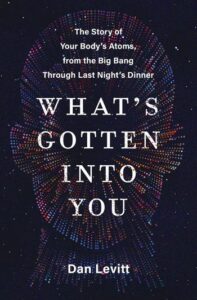
Excerpted from What's Gotten Into You: The Story of Your Body's Atoms, from the Big Bang Through Last Night's Dinner by Dan Levitt. Copyright © 2023. Available from Harper, an imprint of HarperCollins Publishers.


No comments:
Post a Comment