Centered between two small houses somewhere in swampy lowlands next to a creek, three people begin to dance. A woman in a green dress bends over slightly. She lifts her heels, stirring the sandy ground beneath her feet. Suspended between her hands, she holds a white-and-blue-striped cloth, pinched by her index fingers and thumbs. She raises and lowers her hands, shaking the cloth in front of her. She wears an apron, a scarf around her shoulders, and a scarf around her head tied at the back.
Next to her, another woman dances, a cloth outstretched between her hands. They dance on their toes. They look like they are floating. The women face a man. He's bent over too, with a dark wooden dowel in his hands. He raises and lowers the staff as he moves his feet, his blue jacket rising as he lifts his arms, his bare feet and red pants gliding across the makeshift stage.
Two instruments drive the music of this dance. To the left of the dancers sits a man with a drum pressed between his knees. He holds a slender stick in each hand, beating out a rhythm. To his right, a man in a hat sits with the round body of a stringed instrument squarely in his lap. The tan, dried gourd amplifies the sounds that burst from the strings.
To modern eyes this instrument may not look like a banjo. It has no circular wooden body, no metal parts. Instead, a flat piece of wood bisects a round gourd, forming the neck and sound chamber. A piece of animal skin sits taut across a circular hole cut into the side of the gourd, a skin that creates the top of the instrument and the soundboard. Around this white circle, the maker has cut intersecting lines into the gourd. Strings extend from the bottom of the gourd, across the soundboard, over a bridge that holds them up, and along the board-like neck to where it comes to a triangular point.
Here, at the headstock, three cylindrical shapes stick out from the piece of wood. The strings attach to these tuning pegs; turning the pegs allows the musician to tighten and loosen the strings to the pitch he wants. Halfway down the neck is another peg, for a shorter string. The short string, flat fingerboard, skin soundboard, and tuning pegs are some of the banjo's defining characteristics.
When the white slaveowner John Rose saw this scene of enslaved Black people before 1790, he felt it was interesting enough to commit to paper. He dipped his paintbrush in a rich red for one man's coat and a warm tan for the stringed instrument, the drum, and a ceramic vessel by the banjo player's feet. Rose was an amateur, but he painted details like the patterns on the cloths the women tied around their hair and the pegs and sound holes of the banjo. There is care in this work: in his brushstrokes and with the people's movements. Looking at it, you feel almost instinctively that something significant is happening.
The banjo did not exist before it was created by the hands of enslaved people in the New World.
Nearly 150 years later, in 1935, art curator Holger Cahill had the gut feeling that the watercolor was important and bought it on behalf of Abby Aldrich Rockefeller, who was collecting American folk art for an exhibit in Williamsburg, Virginia. The watercolor was unlike anything Cahill had seen, and its depiction of uncaricatured Blacks in the early United States still makes it unique. In the years since it was first displayed, the image has gained the title The Old Plantation and has been reprinted in books, on museum walls, and on CD and record covers.
This rare piece of art is one of the most significant images of early African American music and dance in North America, and one of the earliest images of the banjo. It was not until the early 2000s that decorative arts librarian Susan P. Shames discovered that Rose was the artist. She considered that the "painting demonstrates one of the closest links between the cultural life and practices of African Americans and the cultural life and practices of their heritage in western Africa," although she had no definitive evidence that the dance was of West African origin.
Most scholars and historians have assumed that what Rose painted was a social dance or a secular celebration. Some have suggested that two of the dancers are jumping the broom, a marriage ceremony among enslaved Blacks in the United States. This reading seems wrong. The painting has no broom. Moreover, the broom ceremony was not a tradition in Africa, hasn't been documented during the period of the painting, and is a folk custom likely introduced to the Americas by Europeans. Other scholars have simply accepted that the painting depicts an African dance, even though searches for an analogous dance in Africa have yielded no results.
*
In 2017, my partner Pete Ross and I wandered through the Rijksmuseum in Amsterdam, which explores eight hundred years of Dutch history through the visual and decorative arts. After hours spent looking at old masters and other paintings from the Northern Renaissance, we heard an announcement that the museum would close in half an hour. We looked over the map, trying to decide which of the myriad rooms to visit before we had to leave. Tucked away in a corner on the first floor was a room with art from former Dutch colonies.
Pete and I play a game in art museums, a kind of treasure hunt that we had always lost. A trained artist and luthier, Pete has spent decades staring at images of early banjos, researching early banjo accounts, and making gourd banjo recreations and reproductions for museums and musicians. Each time we visit a museum, we joke, "Today we are going to find an image of a banjo that no one has ever noticed before."
We come across works we've seen in print or online. At the New-York Historical Society in Manhattan, we found ourselves in front of Negro Life at the South, a well-known 1859 oil painting of a scene in Washington, DC, with a Black man playing a banjo. The idea of finding a lost banjo image always feels both ludicrous and hopeful.
On one hand, how would we discover something new in a painting that has been hanging on a museum wall and been seen by thousands of people every day? Surely we would have known of it already, or we could find it on the internet with a simple search. On the other hand, we know that the banjo's early history, its African American history, has been willfully hidden and distorted. Only three early gourd-bodied, African American-made banjos exist today, and Pete and I are the only people to have examined all three. It wasn't until the 1970s that the white librarian Dena Epstein published a book outlining pre-Civil War sources that mention Black banjo playing, and she admitted that even after looking through tens of thousands of pages of documents, she still hadn't mined every source. Known images of the banjo before 1820 number less than fifteen.
This all makes it feel like we could find a treasure in our game. We chose the room of Dutch colonial art because two of these three earliest banjos are from the South American nation of Suriname, formerly Dutch Guiana. We thought the art would expand the landscape of Suriname for us and might help us understand those banjos better.
Entering the room, we saw a wall of dioramas, each about as wide as a dining-room table. As I moved from one intricate papier-mâché scene of Suriname in the early 1800s to the next, I felt like I had been transported. Blue, white, and green buildings line a waterfront as sailors hoist the canvas that will take them away from this South American jungle. Black men in white uniforms and top hats row a green boat. Mules drag wagons past women in light-colored dresses with umbrellas over their shoulders. A cow munches on grass.
Then I saw it.
"There it is," I said, astonished.
He's no bigger than my thumb: a Black man leaning against a tree. He wears white pants, a blue shirt, and a headdress of feathers. He tucks an instrument into his right shoulder. It can't be bigger than my fingernail, but there it is: a gourd banjo. The back of the instrument rounds where it meets the player's body. The neck, though, might be shorter than that of a banjo.
I read the information card: Waterkant van Paramaribo, 1820, by Gerrit Schouten.
I coaxed Pete over. He looked less excited than I thought he should. His disposition is calmer than mine, but he also wasn't convinced that the instrument was interesting. The way the man holds it up on his shoulder makes it look like a fiddle. Pete has seen many indistinct images of banjos, images that he didn't think were accurate enough to learn something from. Feeling that this was probably just another inexact or caricatured version of the banjo, he moved on.
I started snapping photos with my phone anyway, trying to get the largest version of the man I could. Pete wandered over to the next diorama. I don't remember his exact words, but "holy shit" is a favorite expletive.
"That's it. That's The Old Plantation," he said.
The scarves. The man and women facing each other as they dance. He'd been staring at that watercolor for decades, never satisfied with the cursory explanations that it just showed a dance. He thought John Rose had painted something unique, something significant, which had never been successfully deciphered. And here was something almost identical. It was almost as if the diorama had been created from the painting. We knew that would have been impossible. Rose had never framed the watercolor, and after his death, it stayed in the family until a woman named Mary Lyles bought it from one of Rose's descendants and sold it to Cahill. It wasn't publicly displayed until the 1930s.
The fact that there was no banjo in the diorama didn't matter to Pete, nor did it matter that the scene was in South America rather than South Carolina. His gut told him that this dance was related to the one in Rose's watercolor. I looked again at the information card next to the diorama. Once again, Gerrit Schouten. I snapped a few more photos, and in the gift shop I bought a book on Schouten and the dioramas. We didn't open it until we got home to Baltimore.
But when I dived into it, the next "holy shit" moment occurred. The book led me to sources and information about the cultural context of the banjo that had been forgotten. When I looked at Rose's watercolor with this new information, I saw cultural practices and belief systems. It showed me the early banjo in the hands of enslaved Africans and people of African descent, and demonstrated that the banjo was part of a culture extending from Suriname to South Carolina to New York. It changed what we knew about the instrument's origins, which I feel also changes our understanding of something that is both symbolic of and important to American culture.
The banjo is the quintessential American instrument and an object in our material culture that can tell us the story of the United States. The banjo did not exist before it was created by the hands of enslaved people in the New World.
Banjo history is also symbolic of African American history: it has been ignored and distorted. All three early banjos are housed in European museums and were only rediscovered in the last forty-five years. Many more that were collected and taken to Europe have disappeared from museums and private collections. "The banjo is African" is often repeated on National Public Radio and in Smithsonian magazine and the New Yorker. But it is not true: the banjo is a uniquely American instrument, crafted by people of African descent. It is structurally different from any African instrument. The rabbit hole I went down made me realize that, like a creolized language or foodway, the banjo can help us explore the way in which African cultures transformed in the Americas and transformed the Americas.
The banjo was not just a musical instrument but a spiritual device, and it fit into a cultural complex of music, dance, and spirituality.
I compulsively researched early accounts of the banjo, which are scarce because those playing the instrument often didn't have the opportunity to record their own history and white people in proximity to the instrument often didn't care to document banjos. As the scholar Saidiya Hartman writes, "Every historian of the multitude, the dispossessed, the subaltern, and the enslaved is forced to grapple with the power and authority of the archive and the limits it sets on what can be known, whose perspective matters, and who is endowed with the gravity and authority of historical actor."
I read and reread every available source for descriptions that might be valuable and rediscovered lost sources—ones researchers, historians, and librarians had used in pursuit of other topics, but not to analyze early American music. Along the way, I became frustrated that white supremacy has distorted this history and that better sources don't exist. I used these sources to understand the context in which the banjo was played and tried to interrogate the bias of writers and observers by learning more about them and the world they lived in. I also looked at my own bias as a Swedish American white woman trying to understand a culture that isn't my own but is integral to American culture.
During my research, I saw the same cultural elements appear in images of the banjo, descriptions of the banjo, and the three existing early instruments. As archeological evidence of the banjo's beginnings is scant, these elements became stand-in artifacts: evidence of behavior, movement, and relationships. The banjo appears in Suriname and New York and everywhere in between. What does that geographic spread say about the culture and lived experience of the people of African descent who created, played, and listened to the banjo? Is it really an American instrument, as we commonly think of it today?
Our biases have limited the banjo to being a secular instrument: it is in the hands of a lone white man on a porch, a backup instrument in a bluegrass band, or a driver of melodies for a square dance or clogging routine. The stereotypes of the instrument from the last 180 years create these images in our minds. The assumption is that the banjo must have always been a secular instrument—from the Latin word saeculum, meaning of the present world. This is putting a Eurocentric worldview on an instrument born of African beliefs and traditions.
From my research, I realized that the banjo once served a higher purpose. The instrument was sacred—a word derived from the Hittite šakla‐i, meaning custom or rites, something of an otherworldly realm, of spirits, ancestors, and worship. The banjo was not just a musical instrument but a spiritual device, and it fit into a cultural complex of music, dance, and spirituality. In the 1970s, when scholars of the African diaspora still had to argue that the enslaved who arrived in the Americas had not been denuded of their culture, poet and scholar Edward Kamau Brathwaite wrote, "There is no separation between religion and philosophy, religion and society, religion and art. Religion is the form or kernel or core of the [African] culture." He warned that when religion is mentioned, a full cultural complex should be considered. I hope to reveal that cultural complex and to have the banjo take us on a journey to remember the hidden, the willfully ignored, the forgotten, and the lost.
__________________________________
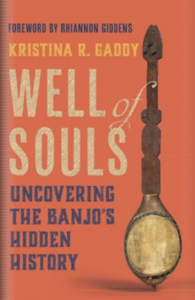
Excerpted from Well of Souls: Uncovering the Banjo's Hidden History by Kristina R. Gaddy, with a foreword by Rhiannon Giddens, published by W. W. Norton & Company.


No comments:
Post a Comment