Mathematical books for the lay public have been around for well over a century now and continue to thrive up to the present. Of their importance, mathematician Harold Ness stated,
If we want to eliminate the misunderstanding of what mathematics is, we must change the way we teach mathematics. We must teach from a culturalogical perspective. We must view mathematics as an integral part of our culture and a significant force in our culture, and we must communicate this to students.
Books written with an eye for exposition can often tie together a wide variety of mathematical concepts bringing greater understanding in readers. Sometimes this understanding can become epiphanic and transformative. During my student days, I definitely had this experience more than a few times. Seven of the books that I have found particularly interesting and useful over the years are included in the list below. I believe each has something to offer to those who are interested in expanding their knowledge about mathematics and its various ecosystems (including applications and education).
*
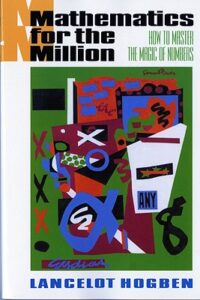
Lancelot Hogben, Mathematics for the Million: How to Master the Magic of Numbers
This classic was written in the 1930s and achieved immense popularity for a math book for the general public. Hogben covers a wide range of topics woven together by a compelling narrative. He includes history and emphasizes how important it is that mathematical advancement not outstrip the general lay person's conception of what is going on (even if they don't understand the details). In fact, he thinks it is downright dangerous when this happens—hinting that mathematics can become almost like a superstition known only to a secretive priesthood. His book is written as an attempt to keep this from happening by filling in some of those gaps of understanding.
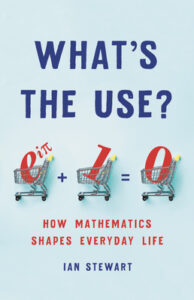
Ian Stewart, What's the Use?: How Mathematics Shapes Everyday Life
In mathematics, by placing our fingers on a given problem, no matter how trite or esoteric it apparently seems, we may end up finding conceptual and computational capital of immense use. How such capital can be effectively spent is very much on display in this well-researched book. Professor Stewart repeatedly shows how problems—with their basis often in pure mathematics—end up having very important applications elsewhere. And while this line of reasoning has often been used, Dr. Stewart supplies fresh and up to date insights. One of particular note is where he shows how a curiosity involving bridges in 18th-century Prussia, has now led to more efficient methods for getting kidneys to those transplant patients most in need.
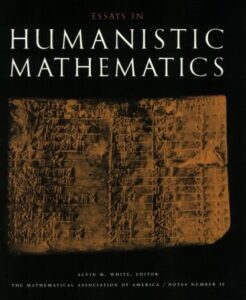
Alvin White, Essays in Humanistic Mathematics (MAA NOTES)
The humanistic viewpoint in mathematics involves presenting math as a subject with deep cultural roots, applicability and even beauty, having the same grand scope and ambitions as other important domains such as language, science, engineering, history, philosophy, music and art. The viewpoint had its origins in the late 19th century and early 20th century and was resuscitated in the late 1980s by Alvin White. White serves as the editor to this collection of articles—from a variety of mathematicians—illustrating how valuable this approach to math education can still be today.
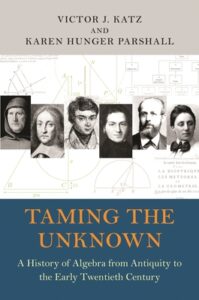
Victor J. Katz and Karen Hunger Parshall, Taming the Unknown: A History of Algebra from Antiquity to the Early Twentieth Century
In recent times, much exceptional work often in the form of articles has been written on the nature and history of algebra: What is algebra truly about? What role did symbolism really play throughout its history?
This excellent and well-researched book provides one of the most powerful historical narratives of algebra that I have yet seen. In regard to its history on elementary algebra, the book strikes the nice balance between providing sufficient technical details without overwhelming the reader. It also goes into very nice depth and detail in discussing the extensive contributions to algebra of medieval mathematicians.
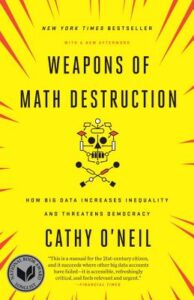
Cathy O'Neil, Weapons of Math Destruction: How Big Data Increases Inequality and Threatens Democracy
A strong introduction to the potential problems with big data algorithms—that impact citizens lives—when they are implemented without serious feedback mechanisms. O'Neil describes it thus
The math-powered applications powering the data economy were based on choices made by fallible human beings. Some of these choices were no doubt made with the best of intentions. Nevertheless, many of these models encoded human prejudice, misunderstanding, and bias into the software systems that increasingly managed our lives... Like gods, these mathematical models were opaque... Their verdicts, even when wrong or harmful, were beyond dispute or appeal.
O'Neil advocates for some sort of infrastructure that serves to audit the algorithms that can impact a large number of people.
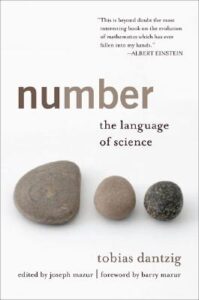
Tobias Dantzig, edited by Joseph Mazur, Number: The Language of Science
Of this book Albert Einstein said, "Beyond doubt the most interesting book on the evolution of mathematics which has ever fallen into my hands." One of my all-time favorites and one of the books that definitely made me decide to study mathematics. Originally published in 1930, it remains in print with the latest edition being published and updated in 2007. In it, Dantzig discusses the origins of counting and numbers from prehistoric times on up to the study of infinity, and includes many quotes from well-known mathematicians and scientists.
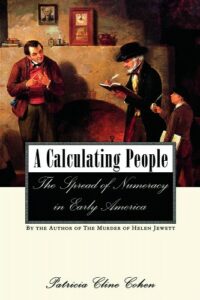
Patricia Cline Cohen, A Calculating People: The Spread of Numeracy in Early America
This excellent book discusses how basic numeracy spread throughout early America especially in the 19th Century. Surprisingly it spread among the common man in America faster than it did among their counterparts in Europe. Cohen attributes this to many reasons including the rise of the Common School (elementary school) combined with the new-found ability of educators to bring the knowledge of basic numeracy down to the first years of schooling and the desire to measure both the sheer growth of the expanding country and the extent of some of its social ills. She also discusses the problems of the 1840 census. One of the conclusions the census came up with was that freedom for blacks caused them to go insane, which was used by many in the south, including John C. Calhoun, to justify slavery using what they saw as mathematical proof. Eventually it was shown, of course, that the data had been badly handled and implied no such thing. This opened more eyes to the hidden dangers in using statistics without paying careful attention to the details of how that data is gathered.
____________________________________
Algebra the Beautiful: An Ode to Math's Least-Loved Subject by G. Arnell Williams is available now via Basic Books.


No comments:
Post a Comment