I wrote a sci-fi book, and yet I don't really love science fiction. As a kid, I liked it. I remember enjoying books by Isaac Asimov and Ray Bradbury, and about a thousand comic books involving space ships and aliens. But then, around fifth grade, I got the idea that a person had to decide between sci-fi and fantasy.
I don't know why I felt like their structures of feeling somehow excluded each other, but I did, and I ended up going down the dirt path of fantasy, following it deep into the realms of Shannara, Prydain, Mordor, etc. By the time I popped out a couple years later, into Salinger and the Beats, it seemed like the world of sci-fi was receding behind me.
Without even trying, though, I've ended up absorbing a lot of sci-fi simply by osmosis. How can a person not? I've seen hundreds if not thousands of cyborgs, scores of tractor beams, dozens of time portals in my day. I've listened to friends talk about Dune for decades.
It's only lately, as sci-fi's apocalyptic turn of mind—that undying fantasy of destroying the world in every possible fashion—has started to seem to me like a collective death wish, that I've started to feel something like an actual antipathy towards the genre. Why is it that every generation has to imagine the world exploding on its watch? Why is it so hard for anyone to imagine the world going on without them?
Anyway, the book I wrote, Denial, is an attempt to get past the dystopian cliches that shape so much of our popular culture, and into something like a post-post-apocalyptic point of view.
All that said, I have a small personal canon of sci-fi books that I totally revere.
*
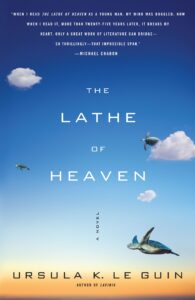
Ursula K. Le Guin, The Lathe of Heaven
I live in Portland, Oregon, where the late Ursula K. Le Guin is a looming, goddess-like presence. As a kid, I loved the Earthsea Trilogy, and her translation of Lao Tzu is a text that I cherish. I love the anarcho-feminism running through so much of her work. For me, though, it's her short novel The Lathe of Heaven that's the best. It's about a man named George Orr whose dreams alter reality, and who falls under the control of a Faustian psychiatrist named William Haber. I think of it as a novel about the horrors of selfhood, the nightmare that obtaining one's deepest desires would actually become. I think wisdom is an underrated virtue in a writer. Le Guin possessed a bottomless well of it.

Philip K. Dick, Valis
I resisted Dick for a long time. I classed him with William Burroughs as a writer for hipsters who otherwise didn't read. I closed my ears to all of Jonathan Lethem's public entreaties in the early oughts. And then, finally, I succumbed. The book that got me was Valis. Like Lathe of Heaven, it's an inner speculative journey, about a man named Horselover Fat whose mind is pierced by a pink beam of light. The pink beam reveals to him an important fact about his life, a fact that he otherwise couldn't know, and ushers him into a world turned into personal signs. Oscillating between first and third person, the book speaks in a deeply learned yet semi-schizoid voice, and performs a deep tissue dissection of life in 1970s Northern California. It's a mind-blower. I was probably wrong about Burroughs, too, but sadly I think the ship has sailed on that one.
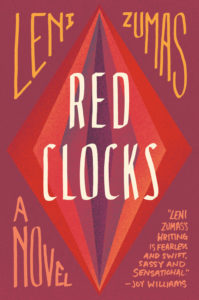
Leni Zumas, Red Clocks
How terrible, that the great writer Leni Zumas should be so prescient about a near future in which abortion rights no longer exist. But she was, and thus her 2018 Red Clocks increasingly doesn't read like sci-fi at all. Which is fine, literarily, because while the political science driving Zumas' concept is utterly sound, the real pleasure here is the grain and light of the reality she conjures. The way people talk, the way people act, feel so lived-in and true. In the coming months, as this book ceases to be fiction, the beautiful clarity of Zumas' descriptive touch will remain.
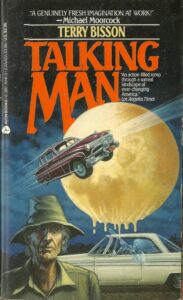
Terry Bisson, Talking Man
The author Terry Bisson and I have a close mutual friend, and from all I've heard, he is a fascinating person. I picked up this book not knowing exactly what to expect, and what I found was something utterly magical. Part Badlands, part 100 Years of Solitude, the book springs from a cusp-moment between the '70s and '80s when American wonder and paranoia were both still actively in play. A young man and young woman meet in Kentucky and head out on the road in an old, white Chrysler. They're on the trail of Talking Man, a mute, junkyard wizard, and chased by a murky figure named Hey Hoss. They eat candy bars. The blood of an elk becomes motor oil. They live out a primeval myth of love and automobiles, sailing through a blacktop America as it never was and always will be.

Charles Yu, Interior Chinatown
Is this sci fi? I think it counts. Yu has written some great science fiction in the past, and in this book deploys much of the puzzley interdimensionality and quasi-super-heroic archetypes that seem hallmarks of the contemporary genre. Not that they've ever been deployed like this, though. A young man named Willis Wu, living his days inside a perpetual production of a TV police procedural called Black and White, consigned, being Asian, to never-ending bit parts, hungers for a better role. Will he ever achieve the status of "Kung Fu Guy"? Will he build a family on the foundations of sacrifice of generations before? In Yu's elegant machinery of worlds nested inside worlds, the emotional stakes continue to torque and torque again, rifling always around a core of seething familial love and guilt. It's just a fantastic, charismatic, funny, heartrending performance, at once incredibly nimble and incredibly deep. How he does it, I have no idea, but, man, he makes it look easy.
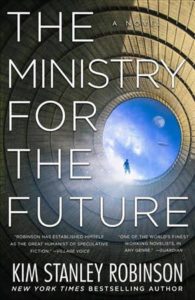
Kim Stanley Robinson, The Ministry for the Future
Happily I hadn't read this book before I wrote my own, because if I had, I surely would've realized I needed to do a lot more research. Not that anyone can compete with Robinson on the level of research. Obama-approved, Davos-certified, this book is a policy paper wrapped in novel form, performing the urgent thought-experiment: what if humanity actually got its shit together and dealt with climate change? Among the most interesting elements in the book are the dark ops involved, the illegal sabotage and murder that would necessarily accompany any rescue mission for earth, but Robinson, decent fellow that he is, leaves those antics offstage. Massively readable, deeply suspenseful, this book, to me, represents the practical turn of mind I crave in writing about the future now. I want a way to imagine a future, period.

Walter M. Miller, Jr., A Canticle for Leibowitz
I said I hated post-apocalyptic literature? Well, this is an exception. Post-apocalyptic, pre-apocalyptic, and post-apocalyptic again, the story begins hundreds of years after an atomic holocaust has decimated humanity. Then, in giant temporal leaps, it follows a brotherhood of monks as they gradually re-invent the tools of civilization, only to fall prey to the same death drive that took them away in the first place. Counterintuitively, the book is hilarious, filled with comic bits worthy of Monty Python or Kingsly Amis, and finally, turns into a theological tour de force. Unlike, say, Frank Herbert, whose sentences are Ayn Rand level wooden, this prose feels channelled from a higher power. I think that's always been my real complaint about sci-fi, the writing just isn't that good. Walter M. Miller Jr.'s, however, is truly great.

Cormac McCarthy, The Road
I said I hated post-apocalyptic literature? Well, this is another exception. The final paragraph is seared in my mind: Once there were book trout in the streams in the mountains. You could see them standing in the amber current where the white edges of their fins wimpled softly in the flow. They smelled of moss in your hand. Polished and muscular and torsional. On their backs were vermiculate patterns that were maps of the world in its becoming. Maps and mazes. Of a thing which could not be put back. Not be made right again. In the deep glens where they lived all things were older than man and they hummed of mystery.
________________________________
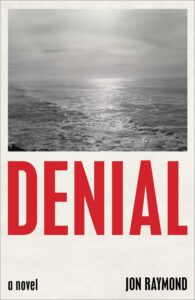
Denial by Jon Raymond is available from Simon & Schuster


No comments:
Post a Comment