At 8:04, everything is secure, in place. It's all I've got, all I can control. Once the ballet begins, who knows? The variables are endless—the tempos, the new girl, a blown light in the fourth wing, a slip. A slip that could end in tearful embarrassment, or end your career completely with a torn Achilles tendon, or a chipped hip bone. We were dancing on the edge before we knew what it was. But we knew where it was. And so I learned early on that everything, anything, that is beautiful is perched on a precipice. Mr. B just placed us there, and it was trust in him that gave us balance.
"Places, please, ladies!" In rehearsals we're "girls," but onstage we're "ladies." Rarely "women." Modern dancers are women: they don't dance on their toe tips, and they have been to college. We haven't. We have barely finished high school. It's the late 1970s. Some outsiders like to highlight the backstage use of "girls" to illustrate how ballet dancers are infantilized, belittled. But they miss the point entirely. We are classical ballet dancers, which is vocation not gender, novices in Balanchine's ministry. We are unconcerned with words, much less semantics—physical manifestation is our sole interest. Besides, we are girls. I am not yet twenty.
This is it. I am alone onstage. With sixteen others. Each so alone. Together. Seventeen pairs of parallel, silky peach toe shoes (we wear Freeds, which are English; Capezios are American and pale pink, rather bourgeois—except Allegra Kent preferred Capezios, but then she proved the exception to every rule) lined up side by side, so sweet, as in a dance shop window. This is so unusual for a ballet dancer: we are always turned out, heels together, toes at opposing ends, a flat line. But for Serenade, in the beginning—as in Eden—we are in that parallel, like ordinary mortals. It is harder to balance, really, and there is such an urge for the feet to pivot, for the toes to pop apart. So strong is our training that parallel feels positively pigeon-toed.
I grab the crisp tulle and pull it up flat against my tighted legs, look down and line up my feet, inside ankles locked together, and then let loose the tulle, refluffing it to remove any finger indents or creases while not budging my feet. My head is turned ever so slightly to the right and the cheek barely tilted, ear toward to the shoulder. Mr. B always told us to turn the cheek as if waiting for a kiss. The kiss of fate, the kiss he might bestow. Being so young, we didn't know we had already been kissed, being there with him and all.
I feel so isolated out here, supported only by air.
The left arm hangs down soft and loose. Right arm up, to the side but a little to the front, palm upward and facing away, fingers soft and separated, middle one heading toward the thumb but not touching. A salute. A protection.
Head and eyes follow the arm, looking toward the uplifted hand. But everything is only hinted at. This arm has been here, there, for nearly ninety years now since Balanchine made this ballet—girl after girl after girl after girl holding her arm in that place. Mine is there now, holding that invisible torch like the Olympic flame. Holding it there until the curtain rises and still after that. Inextinguishable.
I feel so isolated out here, supported only by air. What a profession to have chosen! No wonder my parents thought college was a good idea. Fifteen years of daily training, 22,000 hours at the barre, and I feel like I might just keel over. Squeeze the pelvis tight, grounding, torso up, lifted, reaching. I think of Muriel Stuart, one of my teachers at the School of American Ballet (SAB), who had studied with Anna Pavlova in England, saying in class in her haughty British accent, "Lift up, and softly drop down." While she said this, she would place two very firm and pointed fingers right under one buttock and dig in mightily, the "lift up" part (that grounds), while placing her other hand firmly on the shoulder, the "drop down" part (that lifts). Ballet is based on physical contradiction—turnout of the hips being its central paradox—and this defiance is one route to the ethereal.
Mr. B appears now, in his dark gray sports jacket and yellow silk cravat, in the first wing on stage right. This is where he stands night after night. It is his wing, right next to the stage manager's giant, black, flashing computer motherboard. No one else stands there, though there is no rule, no sign. He bends his right elbow, leaning it along the two-inch-wide horizontal wood plank that braces the back of the wing. He props his face on his knuckles, his hand a curl. If he were only one inch more to his right, he would be visible to the audience, the profile of his nose passing from backstage to onstage. But they don't know he is there; he is visible only to us, onstage with us.
Not only does everyone notice his quiet appearance, but every muscle in every body onstage receives a mad rush of adrenaline as we stand in our places. The only one we care about is here now. As young girls, we are all scared of him—he has the love we want, the only love we want—and yet, really, I see now, we are him in our every move. He is ready for the show.
As the second phrase of Tschaikovsky's violins repeats, the heavy gold curtain lifts swiftly upward and a cool breeze blows across the stage as the cavernous space of the audience enters our private world. Squeeze harder; pull up. Don't breathe. This is not a moment to be mortal. I am a Balanchine dancer.
*
The two great men of my life—George Balanchine and Lincoln Kirstein—are dead. While I have a certain detachment from New York City Ballet now—it is a very different company from the one I danced with and over a hundred other companies around the world now dance Balanchine's ballets—I remain incapable of neutrality toward Serenade, or the man who made it. I see Lincoln up there now in his black, double- breasted Savile Row suit, hovering with his eagle's gaze on my flagrant, unchecked subjectivity.
As for Mr. B, what would he think of my reflections on his first American ballet? I imagine him saying "Too fancy!" as he did when one critic deciphered one of his ballets. "Why do Americans," he asked, "always have to see meaning in everything?" I am one of the dancers Balanchine chose for the New York City Ballet between its official founding in 1948 and his death in 1983—we stand at fewer than five hundred in all, many already gone, others going each year, a few hundred still here, reduced; we are a dying breed. By the turn of the 21st century, while his ballets thrived around the world, no dancer he chose remained on a stage still performing.
A finite few now, we are his druids, he the father of us all. I was one of the very last he chose when he was old and legendary, and I was seventeen. I lived in his world from age 10 to age 26—17 years. But once you've lived there, you never leave.
__________________________________
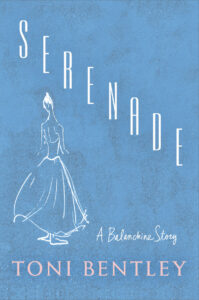
Excerpted from Serenade: A Balanchine Story by Toni Bentley, available via Pantheon Books.


No comments:
Post a Comment